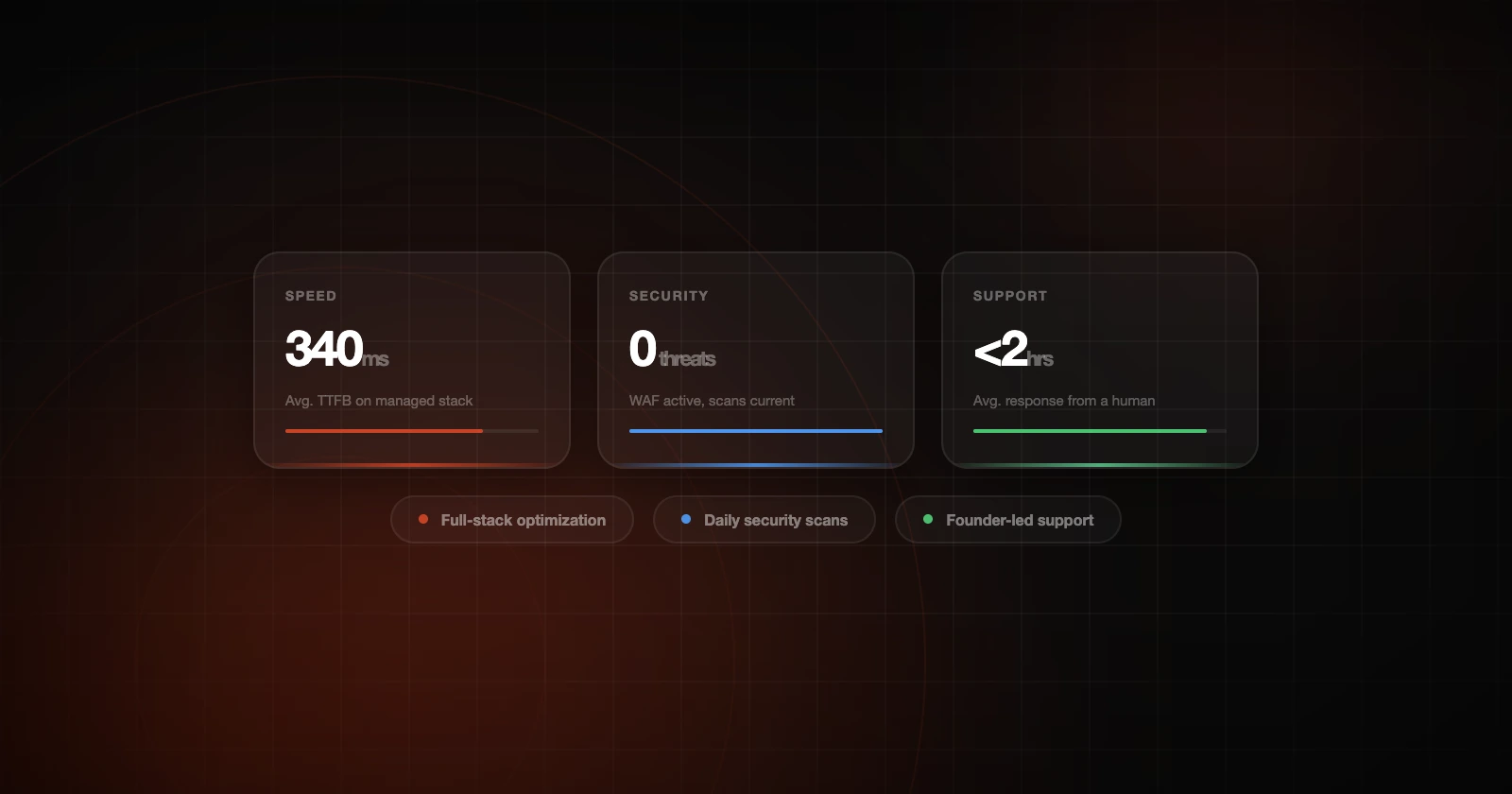
When people compare hosting, they often look at one thing at a time, such as speed, price, storage or support. For a business website, what counts is how those pieces work together, and good managed hosting is built around three connected priorities: speed, security and support.
Think of it as a triangle: if one side is weak, the whole site becomes less reliable. A fast site that's poorly protected is fragile, a secure site with weak support is stressful, and a support team that can't improve performance leaves the site underwhelming.
Speed builds trust quickly
A fast website feels more professional before a visitor reads a single line of copy, and it makes the business seem more credible and easier to work with. A slow site gets in the way just as a visitor is deciding whether to trust you.
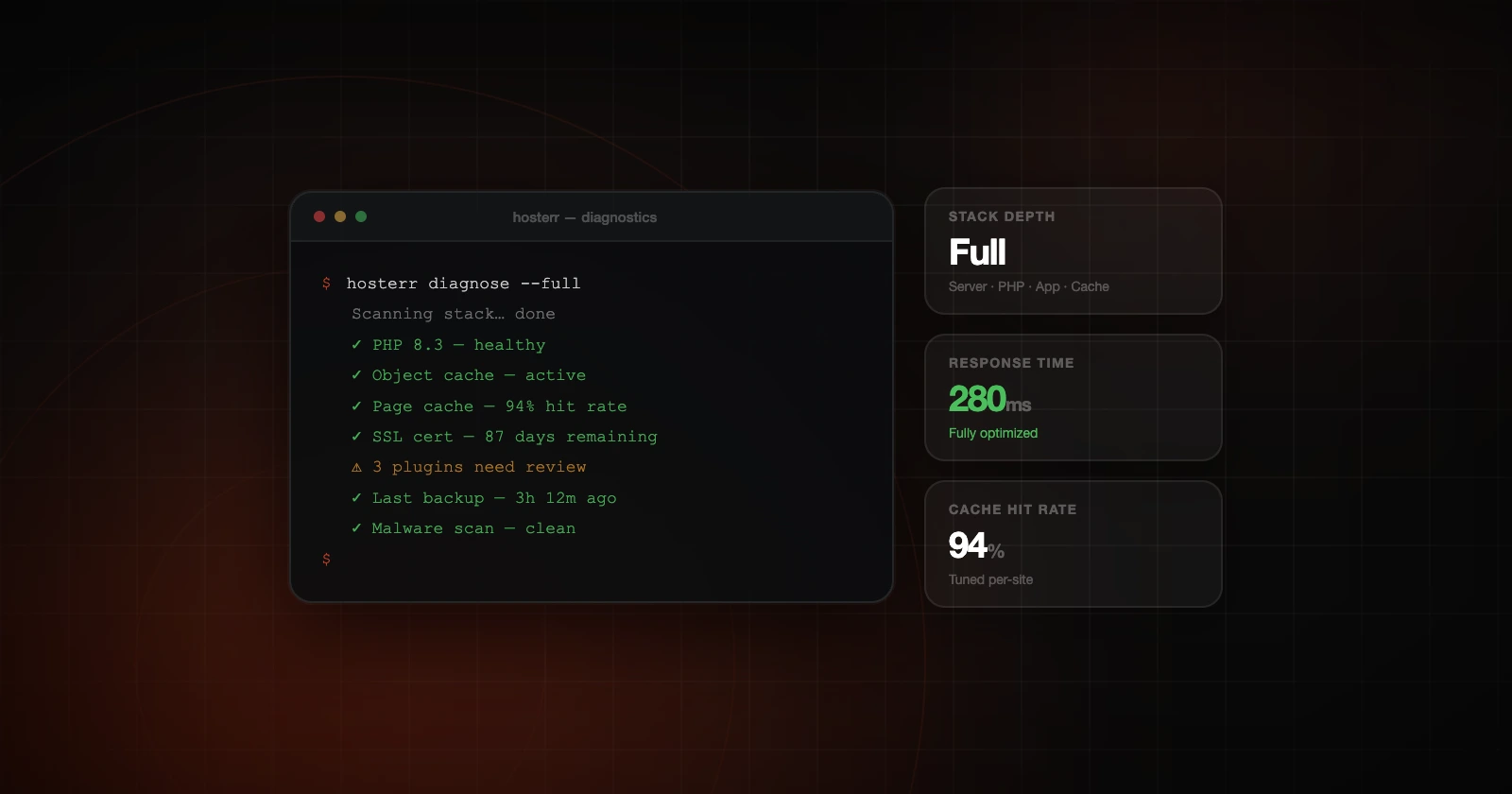
Managed hosting should keep the site consistently fast. That means paying attention to caching, server behavior, database health, images and scripts. Speed isn't something to check once and forget, because it slips as the site changes.
Security protects the foundation
Security protects the reputation of the business as well as its data. A compromised website can damage trust, interrupt operations and leave you with cleanup costs.
No host can promise a site will never be compromised. Good managed hosting focuses on practical protection (updates, hardening, monitoring and backups) and keeps it current as the site changes.
Support is tested when something breaks
Support is easy to overlook until something goes wrong, and then it's the most important part of the relationship. Replying quickly is only part of it. Good support means understanding the site, diagnosing the issue clearly, explaining it in plain terms and seeing the problem through to a fix.
Generic support often stops at the edge of the server. Managed support should know the website well enough to tell whether the issue is the hosting, the code, a plugin, caching, DNS, forms, email or a third-party service.
These priorities reinforce each other
In a well-run website, speed, security and support overlap all the time. A security plugin can cause a performance problem, and a security fix can affect caching. A support request can reveal a deeper maintenance problem, and a good backup strategy makes a security issue much easier to deal with.
Managed hosting works best as an ongoing relationship, where the provider understands how a change in one area affects the others.
What this looks like in practice
Your site isn't left alone after setup. Performance gets reviewed, updates are handled carefully, backups are part of the plan, and support has enough context to be useful.
You also aren't expected to coordinate the technical side every time something feels off, because someone else can look at the whole picture and make the call.
How Hosterr does it
At Hosterr, performance, security and support are handled together as one service. If you're still comparing hosting only by monthly price or storage space, it may be time to think about what your website needs to be run properly.
For a broader view of why basic hosting falls short, read why generic hosting holds business websites back. If you'd like someone to look at your site, get in touch.
Questions to ask when evaluating managed hosting
If you are comparing providers, ask how they handle all three sides of the triangle. What do they do for performance beyond providing server resources? How are updates, security, and backups handled? What happens when an issue involves the website itself rather than the hosting account? Who is responsible for making sense of the problem?
Good answers are specific. Generic promises like “fast servers” and “great support” don't tell you how the service works day to day.
Why one weak side creates stress
Weak speed hurts your marketing and sales, weak security leaves the business carrying avoidable risk, and weak support turns small problems into frustrating ones. So judge managed hosting on all three together rather than on one headline feature.
Many businesses discover this only after a problem. The site may have seemed fine until a campaign sent more traffic, a plugin update caused an issue, or a support ticket revealed that nobody understood the site. A stronger foundation means fewer of those surprises.
Knowing the site is looked after
With the right host, you know the site is being watched, backups are part of the plan, and performance isn't being ignored. You also know there's someone to contact who can think through the whole site, not only the server.
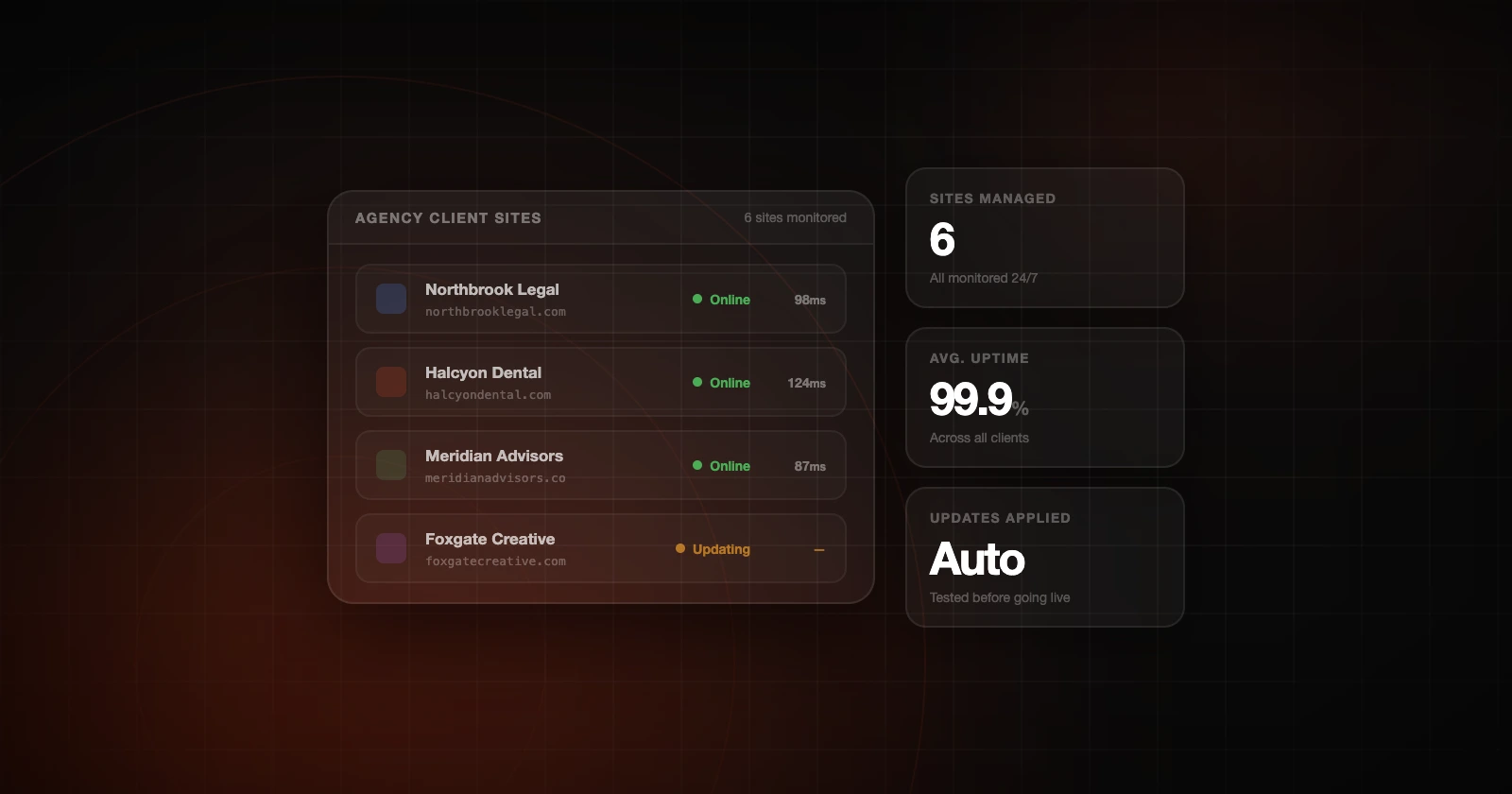
That lets business owners, agencies and their teams stop treating the website as a constant technical worry.
How this supports growth
As a business grows, the website usually has more to do. More traffic, campaigns, integrations and content all put pressure on the technical foundation, and speed, security and support need to keep up.
Frequently asked questions
Is managed hosting only for large businesses?
No. Managed hosting is often most valuable for smaller businesses that don't have technical staff in-house. If the website brings in leads or sales, or the business relies on it day to day, it deserves a professional foundation whatever the company's size.
How is Hosterr different from standard hosting?
Standard hosting usually gives you space to run a website. Hosterr also looks after performance, maintenance, security and backups, with technical support straight from a developer.
Can managed hosting improve SEO?
Managed hosting doesn't replace content strategy or search engine optimization, but it supports the technical foundation SEO depends on. Faster pages, fewer errors and better uptime can all help your search visibility over time.